
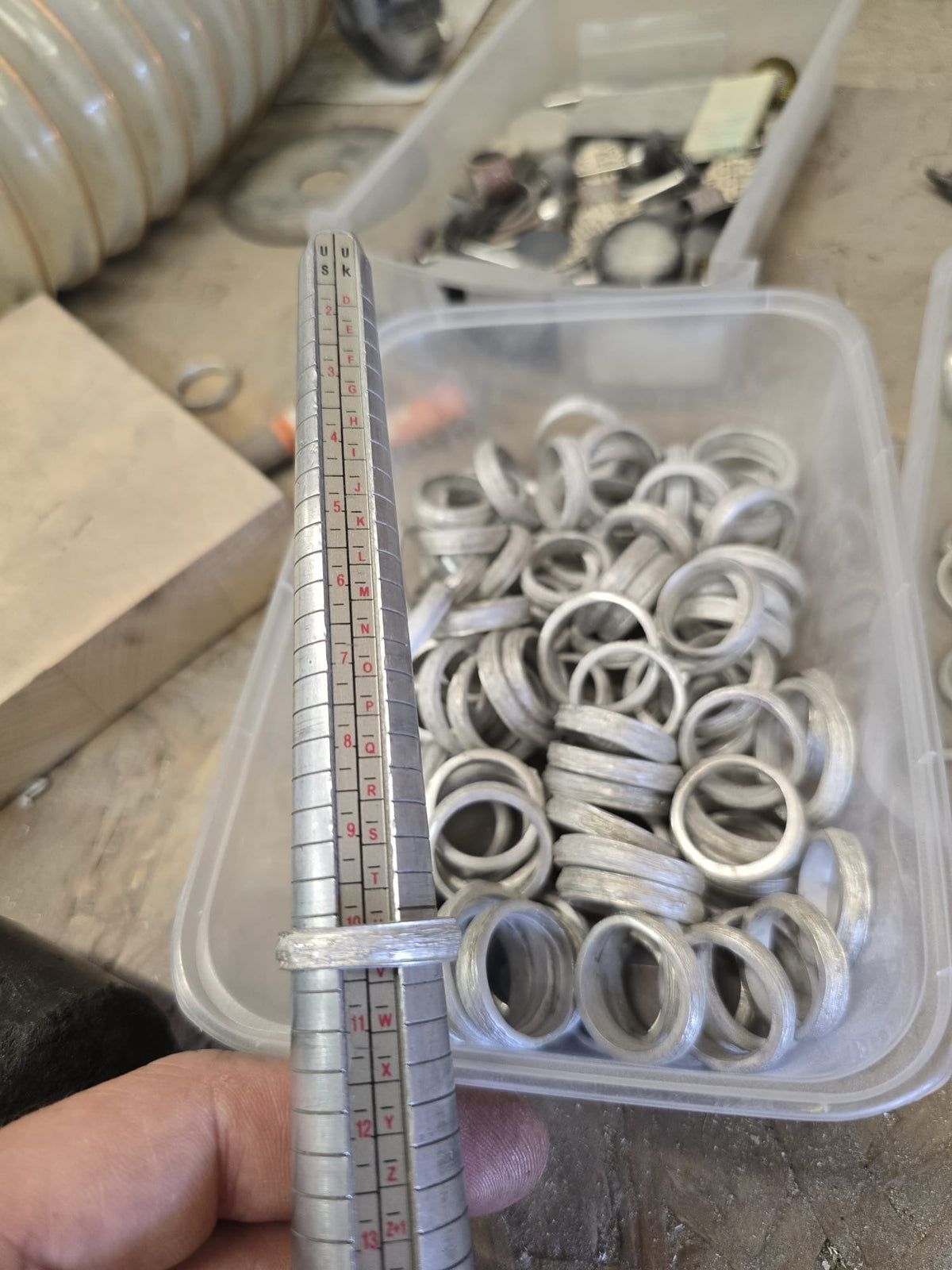
Most people who buy a tin anniversary gift never see where it came from. This is a walk through the workshop in Helston, Cornwall where ours are cast, finished, stamped and packed, and what actually happens between an order arriving and a parcel leaving.
In short: our tin gifts are made in our own workshop in Helston, Cornwall. Pieces are cast from molten tin, sanded and polished by hand, and personalised by hand stamping or laser engraving. Every piece is checked before it's packed, and we aim to send every order within one working day.
Setting the Scene
Walk in and the first thing you notice is the noise. The large vibratory bowl, which can polish hundreds of items at once, sits near the back of the workshop and hums with a deep, steady note. Alongside it, extractor fans run all day, pulling dust away from the sanding wheels.
The smells change with the job. When the laser engraver is cutting plywood or engraving the boxes that our family figures come in, you get a warm, scorched smell. In the covered area where the UV printer lives, there's the chemical tang of ink. Every few weeks the kiln goes on for a bronze cast, and the room fills with the very particular smell of burnt wax. In the packing room it's straw and cardboard.

The layout follows the life of an order. Come in through the staff room, which has a small kitchenette, and turn right to find three casting and sanding stations. On the far wall are the drawers of pre-cast jewellery, a stamping and engraving station, sanding and buffing wheels and a soldering station, with small tools everywhere you look. Round the back is the bronze casting area, with a kiln, a vacuum investment casting machine, a wax injection pot and vulcanisers for both the tin and pewter moulds and the bronze ones. Beyond that is the laser area, with five laser engraving machines and a big workbench that's usually covered in pieces halfway through being made. Come in the other way and you walk straight into the packing room, where there's usually someone working through the day's orders.

We moved into this workshop in 2018. Our previous space was about a fifth of the size and we were running out of room fast. Kevin had run a couple of smaller workshops before that, each one outgrown in turn. We never thought we'd fill this one, and it already feels small.
The working day runs from 7am to 3pm. Mornings are for emails, Etsy questions and printing the day's orders. After that, one person is on the laser, one is in production and one or two are packing. There are four of us here most of the time (three full-time, one part-time), with an extra pair of hands over the summer.
Where the Tin Comes From
We buy our tin as one-kilo ingots from a supplier in Scotland. It's the same supplier we use for pewter, and we also melt down scrap pewter that we buy online.
Cornwall's tin mining history is the reason tin and this county go together in most people's minds, so it's fair to ask whether our tin is Cornish. The short answer is partly. We add some Cornish tin to our tin pot, but the bulk of it comes from our supplier. The Cornish mines were shut for a long time, which makes local tin very hard to get hold of. They're now opening up again, so we hope to source more of it locally.
Price is a real factor. Tin has gone up a great deal in cost in recent years, but we still continue to produce some of the UK's finest Tin Gifts.
Beyond the metal, we keep other parts of the supply chain close where we can. Our diamonds come from London. Most of our boxes come from Kite, which uses recycled cardboard. The small tags that go out with tin orders are printed by a local supplier, and some of our products are made in partnership with St Justin, who are also local.
From Raw Material to Finished Piece
Here is what happens to a tin piece once an order comes in:
- The order is printed.
- The item is cast from molten tin in a spin casting machine.
- The edges are cleaned up with a sanding wheel, file or similar.
- The piece is polished, either in a barrel with ball bearings or in the vibratory bowl with ceramic chips and a soap solution.
- If it's a highly polished piece, it's then buffed with a polishing compound and cleaned.
- It's packed with everything that goes with it (chain, earring hooks), plus the tags and the order form.
- The parcel goes into a mail sack, and Royal Mail collect at around 3pm.
We usually work in small batches, but if you were making a single piece from scratch, the time adds up quickly. Casting takes perhaps five to ten minutes, sanding thirty seconds to a minute, then another thirty seconds to a minute on the buffing. That's with an experienced person doing it, someone who has had time to learn how to be quick and accurate.
Some pieces take longer. Cufflinks need extra time for soldering. Larger items need to spin for longer in the casting machine to form properly. Diamond pieces are usually set overnight with a two-part glue. Family figures are done in batches, at around thirty seconds to a minute of sanding each. Pieces spend a good two to three hours in the vibratory bowl, which also tends to clean up small blemishes. Bronze pieces are a separate, two-day process, though they're not really part of our tin gifts.
Where the skill sits depends on the piece:
- Casting takes some finesse. The pressure and the spin speed both have to be right for the mould you're using.
- Diamond pieces, and bronze ones, need a high shine, which means polishing and buffing without leaving scratches.
- Soldering cufflinks takes experience.
- Stamping is a skill in its own right, and it's how we put a personalised message on some of our products.
- Laser engraving needs a good understanding of the software.

Personalisation and Engraving
We personalise in two ways, and only two: by laser engraving, and by hand stamping. Which one we use depends on the piece.
Take our personalised beaten round cufflinks. The customer gives us the year they were established, whether they'd like Mr & Mr, Mr & Mrs or Mrs & Mrs, and their surname. We planish the surface of the cufflink, stamp the engraving by hand as requested, then solder the cufflink back together.
Family pieces work differently. The customer gives us their saying, we put it into the laser engraving software, and the laser cuts the custom message. Some items, like our You Are My Rock rocks, are stamped by hand if they have a custom message.

Longer names can be harder to stamp. The trickiest request is usually initials on the sides of rings, which is a very small area to work in. And if we stamp or engrave something wrong, which happens occasionally, we simply remake the item.
The People Behind the Craft
Some of what we do was self-taught, and some came from previous jobs. Adam, for example, spent three years at St Justin and learned a good deal there.
Working with tin and pewter is a niche skill. When it comes to jewellery, most makers work in silver, which is a different set of skills. We haven't heard of anyone setting out to learn to make things from tin or pewter.
The hardest things to teach a new starter are speed and an eye for detail. Many people take a while to get used to the sanding wheels and to multi-tasking in production.
There are two things that tend to surprise people. One is how clean the pieces come out of the vibratory bowl or the ball bearings: you put in a rough, freshly sanded piece, and what comes out looks pretty much finished and shiny. The other is the molten metal. It sits at around 270°C, and it tends to surprise new staff how hot it is just sitting there.

Quality Control
Every item is inspected as it's packed. We look for marks and scratches, dirt or debris, fingerprints that need a wipe or a re-polish, and misspelled personalisations.
A piece gets reworked or remade if we find sharp edges, a pendant where the necklace eye hasn't been drilled out enough, a misspelled or mistyped personalisation, polish or dirt trapped in the piece, a part that hasn't cast properly or has blemishes, a broken wooden box, or a cufflink back that hasn't been soldered properly.
The process hasn't changed much. We double-check everything throughout. A few years ago, when we got busier, we had a separate quality control step where someone else checked items as they came out of production, so every piece had a second pair of eyes on it. We've always tried to produce the best we can.
What Handmade Actually Means Here
It's worth being clear about what we mean by handmade, because it isn't the same as made from scratch each time.
Every design started as something made by hand, or was made from a handmade master that's been turned into a mould. Most pieces are made from those moulds. Each one is poured by hand and spin cast, then sanded and polished by hand. The beaten pieces usually need re-beating, or planishing, with a hammer, which gives the hammered effect and makes each one unique. Anything personalised by stamping is stamped by hand.
Tin and pewter is a small field, and most people working in it use methods similar to ours, so there isn't much of a mass-produced version to compare against. What we can say is that anything we planish or stamp carries the mark of a human hand, and no two pieces are the same. Each one is sanded slightly differently, and each one comes out of the polish slightly differently.
We still get at least one customer a month who comes to collect their order, if they're local or on holiday, and we've talked them through some of the processes while they've been here.
One piece in particular has stayed with us. We make angel family figures, for children and for adults. We created them because someone got in touch to ask whether she could have a figure to commemorate her child who had passed away. We now make them for cats and dogs as well, and they're a popular product.
FAQs
Where is the workshop?
We're in Helston, Cornwall, the town best known for its Flora Day. The workshop is on a small industrial park alongside Ann's Pasties and the Marconi building yard, as well as a number of other small businesses and a gym.
Is your tin Cornish?
Partly. We add a little Cornish tin to our tin pot, but most of our tin comes from a supplier in Scotland. Cornish mines are starting to reopen, so we hope to use more local tin in future, depending on price.
Is every piece really handmade?
Every piece is sanded by hand, and everything goes through a casting machine. We don't make each item from scratch. Designs begin as handmade originals or handmade masters, pieces are poured by hand into moulds, and the finishing, planishing and stamping are all done by hand.
How long does it take to make and ship a personalised piece?
We aim to get most personalised pieces out within a day. In fact, we aim to send all orders within one working day.
Can I visit the workshop?
We haven't had many people ask, but it's something we could offer. If you're local or on holiday in Cornwall, get in touch and we'll see what we can do.
Conclusion
Behind each tin anniversary gift there's a small team in Helston, some very hot metal, and a lot of sanding. The pieces are cast, but they're finished, stamped and checked by people, and that's what makes each one a little different from the next.
If you'd like to see what comes out of the workshop, browse our 10th wedding anniversary gifts collection, including our tin cufflinks and tin necklaces and pendants. For the story behind the tradition itself, our guide to what the 10th anniversary means covers it.
